
Anti-Trauma Rubber Surface for Paratrooper Landing Zones and Training Fields | EPDM pre-consumer | Paratrooper Runway
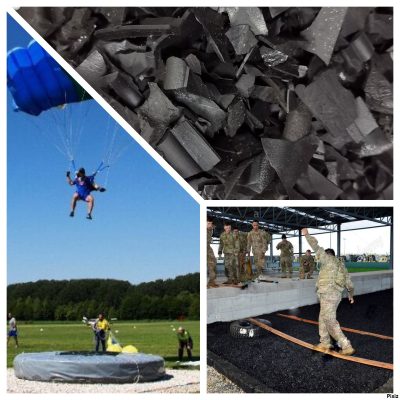
Paratrooper Runway is Prismi’s specialist range for the construction of anti-trauma surfaces for paratrooper landing zones and military and civilian parachute training fields, manufactured in Italy since 1990. The Parafloor product, 100% pre-consumer EPDM/SBR rubber granule in coarse 6–12 mm particle size, was developed and supplied to military barracks to guarantee safety during fall training exercises, where freedom from steel wire (NO TYRE) and freedom from staining pigments (NO STAIN) are essential requirements.
With an absolute density of 1.18 g/cm³ and hardness of 58–62 Shore A, Parafloor granules do not blow away in wind, do not shift under repeated impact, and provide calibrated cushioning matched to the parachuting landing scenario. Standard quantity: 5 kg/m² per 10 mm of layer depth.
The same surface finds application in the civilian sector: sport parachuting schools, parkour and free running centers, stunt training academies, indoor skydiving simulators and survival/adventure sport facilities. Contact us for a tailored quote.
Applications | military and civilian parachute training with Parafloor
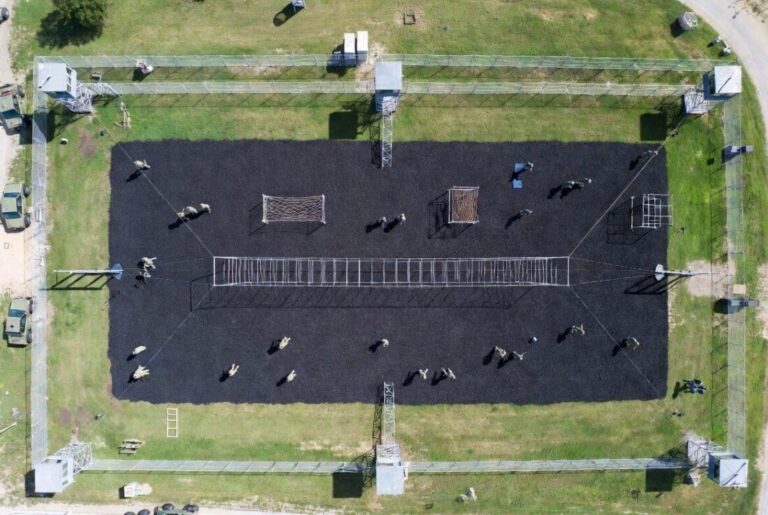
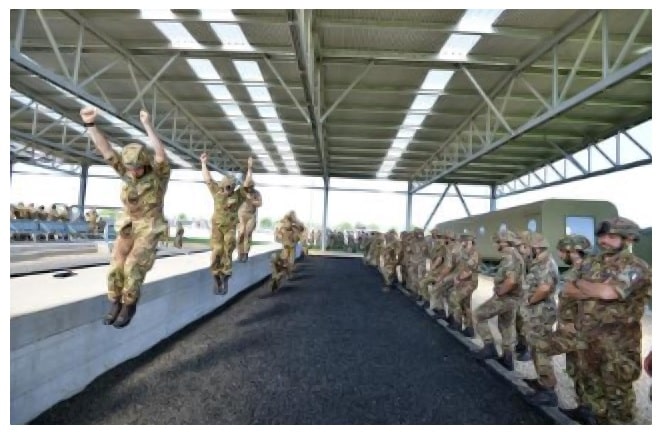
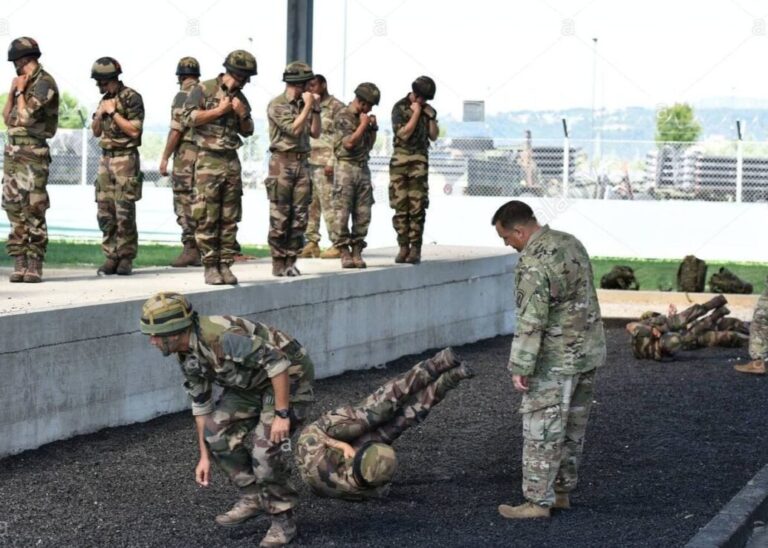
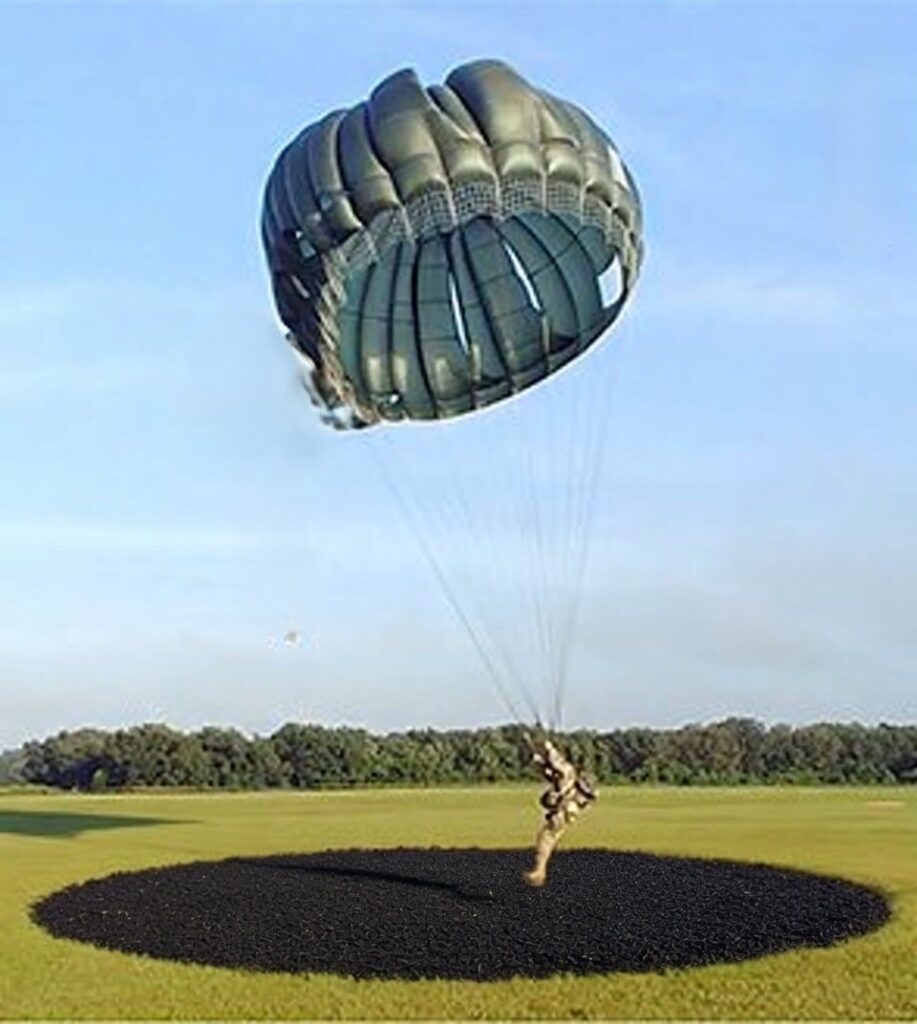
Parafloor installations serve two main configuration types, both documented with photographs in the Italian version of this page.
Open linear field: Parafloor 6–12 mm granules are spread loose on the ground in fall and slide zones, perimetering the landing areas below jump towers. The layer depth depends on the height of the training structures and the safety requirements of the facility operator.
Circular training pad: the most widely used format for repetitive landing technique training. The circular perimeter in black Parafloor granules provides a consistent surface that cushions repeated impacts throughout training sessions, for both military parachute training and civilian parachute schools.
Where Parafloor is used | military and civilian applications
Parafloor was originally developed for military parachuting, where material purity, safety compliance and freedom from staining are priority requirements. The same technology applies effectively in these contexts:
Military and law enforcement training: landing zones for barracks, paratrooper training centers and advanced jump courses. The 6–12 mm particle size guarantees surface stability even with repeated impacts and adverse weather conditions.
Sport parachuting schools: indoor and outdoor drop zones for AFF (Accelerated Freefall) parachuting schools, national training centers and athlete preparation facilities. The Parafloor surface requires no specific maintenance and does not compact over time.
Parkour, free running and stunt training: landing zones in parkour centers, stunt film academies and training pits require a surface that cushions impact without excessive give. Parafloor offers the right balance between shock absorption and stability.
Indoor skydiving simulators: transition zones in indoor skydiving centers and vertical wind tunnel facilities use impact-absorbing surfaces in the lateral landing areas.
Survival camps and military simulation activities: private fields for survival, airsoft and paintball that replicate training environments with jump towers and obstacle courses.
Parafloor technical specifications
Parafloor | coarse EPDM/SBR granule 6–12 mm for parachute training surfaces
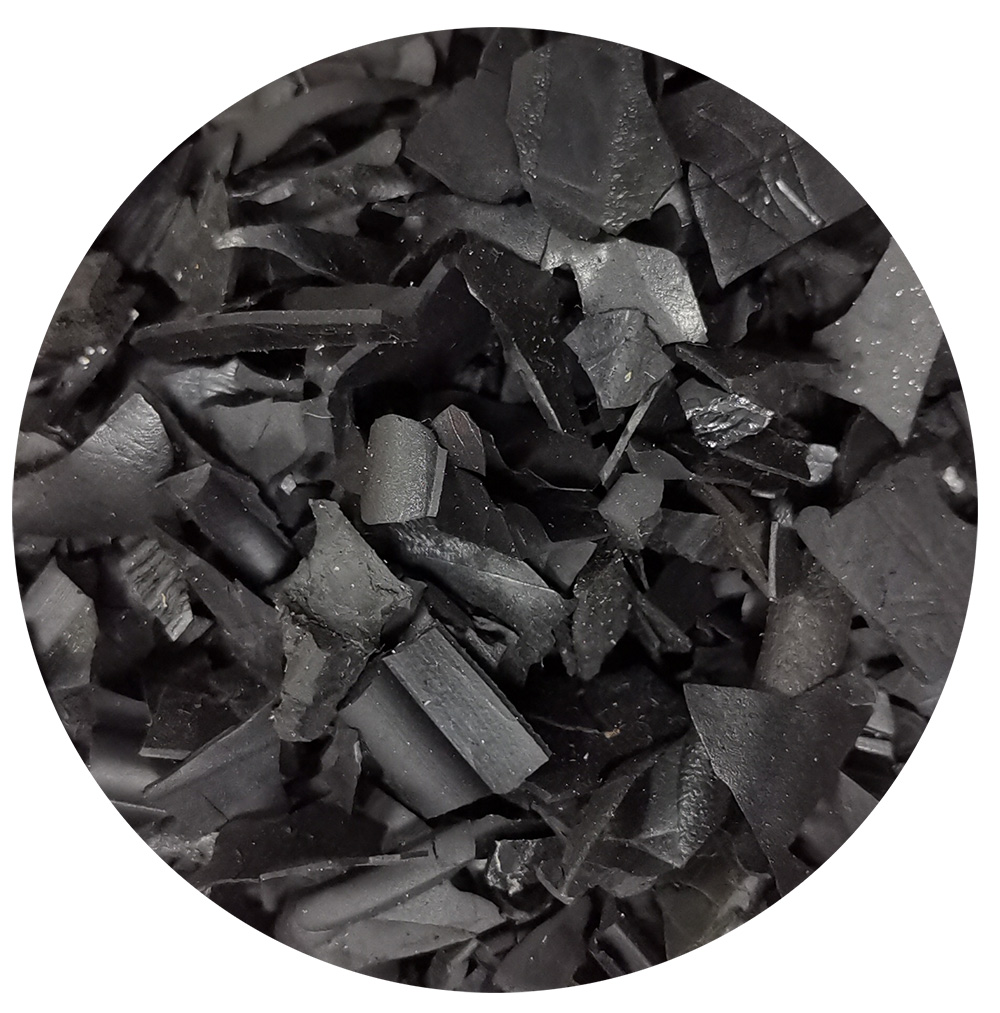
Parafloor is Prismi’s 100% pre-consumer vulcanized EPDM/SBR rubber granule for anti-trauma surfaces in paratrooper landing zones and parachute training fields. Coarse 6–12 mm particle size, in-mass black coloring. Hardness 58–62 Shore A. Absolute density 1.18 g/cm³. Standard quantity: 5 kg/m² per 10 mm of depth. Impurities below 0.001% by weight. Particle size analysis per EN 933-1. Certified NO TYRE (not from recycled tyres) — NO STAIN (does not stain). Light stability 95%, abrasion resistance 97%. Technical data sheet available.
Designing a landing zone, training field or anti-trauma area for parachuting , military or civilian?
Contact us to receive the full Parafloor technical data sheet and a direct-from-manufacturer quote tailored to your project.
Frequently asked questions about Parafloor rubber granules for parachute training
What does the NO TYRE certification mean for Parafloor, and why does it matter for safety?
The NO TYRE classification indicates that Parafloor is produced exclusively from pre-consumer EPDM/SBR rubber from industrial production scrap — not from recycled post-consumer tyres (ELT/PFU). This guarantees two critical safety advantages: the complete absence of residual steel wire (which can remain present even after deferrization in ELT granules, posing laceration risk during falls) and the absence of organic contaminants typical of used tyres (oils, stearates, phthalates). With impurities below 0.001% by weight, Parafloor is the highest-purity granule available for this application.
What depth of Parafloor is required for a paratrooper landing zone?
Optimal depth depends on the height of the training structures and the intensity of the expected impacts. Standard Parafloor quantity is 5 kg/m² per 10 mm of depth (±10%). For fall heights of 3–5 meters (typical of military jump towers for paratrooper training), loose-layer depths of 20–40 cm are generally used. For lower heights (1–2 meters, typical of sport parachuting courses and parkour) 10–15 cm is generally sufficient. Contact us with the specifications of your facility to receive a tailored technical recommendation.
Can Parafloor be used for civilian sport parachuting schools as well as military training?
Yes. Parafloor is equally suited to both military training and civilian sport parachuting. AFF (Accelerated Freefall) parachuting schools, national training centers and drop zones with indoor jump structures use this type of surface for low-altitude technical fall exercises. The Parafloor surface requires no specific maintenance: it does not compact over time, does not produce dust, does not stain uniforms or equipment and does not require seasonal replacement. It is also suitable for parkour centers, stunt academies and indoor skydiving simulators.
Does Parafloor granule shift or blow away during falls and in wind?
No. The coarse 6–12 mm particle size and absolute density of 1.18 g/cm³ — above 1, meaning the granule sinks in water — ensure that Parafloor stays in the installation zone even in wind, rain and during repeated impacts. This distinguishes it from sand and fine-granulometry products (0.5–2 mm) which tend to disperse under wind or impact. The granule naturally redistributes under foot traffic without scattering, because the mass per individual granule is sufficient to resist the dynamic forces involved in parachute landings.
Does Parafloor require a binder to install, or is it used loose?
Parafloor is typically installed as a loose layer without binder: the 6–12 mm granules are simply spread with a shovel or mechanical equipment to the required depth. No polyurethane resin or other bonding agent is required. This makes installation fast and economical, and allows the material to be repositioned or replenished at any time. Alternatively, for permanent installations or areas requiring a compact surface (for example, the perimeter of fixed circular training pads), Parafloor can be cast in place with polyurethane binder like other granules in the Prismi range. Contact our technical office for the most appropriate solution for your facility.