Tender Specification for Poured-In-Place Anti-Trauma Surfaces
Tender Specification for Poured-In-Place Anti-Trauma Surfaces | CAM Compliance Guide for Contracting Authorities
This article is addressed to Public Administrations and Works Directors who must comply with Minimum Environmental Criteria (CAM) when commissioning playground anti-trauma surfacing.
The current state of public tenders for anti-trauma surfaces
The public procurement landscape for anti-trauma playground surfaces presents a critical and largely overlooked problem. Municipalities and public bodies routinely issue “standard” tender specifications that nominally require compliance with Italy’s Minimum Environmental Criteria (CAM) — yet in practice, these specifications are drafted in ways that effectively exclude certified recycled products from the market, inadvertently generating a de facto monopoly.
This article provides technical clarity for Works Directors and procurement officers, and offers a concrete model specification that genuinely complies with CAM requirements while ensuring open and fair competition.
Available products for CAM-compliant anti-trauma surfaces
Two main methods exist for installing anti-trauma playground surfacing:
- Prefabricated anti-trauma tiles (e.g. 50×50 cm slabs), with variable thickness calculated for HIC performance per UNI EN 1177.
- Poured-in-place continuous anti-trauma surfacing, with variable thickness calculated for HIC performance per UNI EN 1177.
Both systems, in public procurement, must comply with the minimum recycled content requirements set out in the CAM for urban furnishings (Ministerial Decree of 23 June 2022).
The key requirement: the mass balance of the finished work must exceed 50% minimum recycled content.
Practical mass balance example: poured-in-place rubber surfacing, 40 mm total thickness
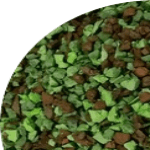
The table below compares two real-world scenarios: one using virgin EPDM granules in the wear layer (a widespread but non-compliant practice) and one using certified E.o.W. coloured rubber granules (fully CAM-compliant).
← Scorri per vedere tutta la tabella →
| Materia Prima | Cert. Contenuto Min. Riciclato |
% di Riciclato |
Uso | Kg/m² per 10 mm spessore |
Sottofondo Kg/m² |
Finitura Kg/m² |
Totale Massa Kg/m² |
Riciclato totale Kg/m² |
% Riciclato totale |
|---|---|---|---|---|---|---|---|---|---|
| Spessore 28 mm | Spessore 12 mm | Spessore 40 mm | |||||||
| ⚠️ SCENARIO 1 — Granulo EPDM Vergine in Finitura | Pratica comune ma NON conforme ai CAM | |||||||||
| Granulo di gomma sottofondo (riciclato) | SÌ | 100% | Sottofondo | 6,0 | 16,8 | — | 36,2 | 16,8 | 46,4% |
| Legante per Sottofondo | NO | 0% | Sottofondo | 0,75 | 2,1 | — | |||
| Granulo Colorato EPDM Vergine | NO | 0% | Finitura | 12,0 | — | 14,4 | |||
| Legante per Strato di Finitura | NO | 0% | Finitura | 2,4 | — | 2,88 | |||
| ❌ Contenuto di riciclato totale: 16,8 Kg/m² su 36,2 Kg/m² — NON conforme ai CAM (soglia minima: 50%) | 46,4% | ||||||||
| ✅ SCENARIO 2 — Granulo E.o.W. Colorato Rivestito in Finitura | Conforme ai CAM — Play Rubber | |||||||||
| Granulo E.o.W. di gomma sottofondo | SÌ | 100% | Sottofondo | 6,0 | 16,8 | — | 27,5 | 23,4 | 85,1% |
| Legante per Sottofondo | NO | 0% | Sottofondo | 0,75 | 2,1 | — | |||
| Granulo E.o.W. Colorato Rivestito | SÌ | 92% | Finitura | 6,0 | — | 7,2 | |||
| Legante per Strato di Finitura | NO | 0% | Finitura | 1,2 | — | 1,44 | |||
| ✅ Contenuto di riciclato totale: 23,4 Kg/m² su 27,5 Kg/m² — CONFORME ai CAM (soglia minima: 50%) | 85,1% | ||||||||
Dati di riferimento: spessore totale 40 mm (28 mm sottofondo + 12 mm finitura) | Norma UNI EN 1177 | CAM D.M. 23 giugno 2022.
E.o.W. = End of Waste (Granulo di gomma riciclata certificato per il contenuto minimo di riciclato — es. ReMade in Italy®).
What the mass balance reveals
Scenario 1 – Virgin EPDM granule in the wear layer: total recycled content reaches only 46.4%, below the 50% CAM threshold. The finished work does not comply, even though recycled granule is used in the base layer.
Scenario 2 – Certified E.o.W. coloured granule in the wear layer: total recycled content reaches 85.1%, well above the CAM threshold. The work is fully compliant and also delivers significant cost savings.
The data is unambiguous: without certified recycled material in the wear layer as well, the 50% CAM threshold cannot be met.
There are also hybrid solutions to avoid the 50% inferiority figure, such as cutting colored rubber surfaces with black granules. The problem, however, remains because data certifying the origin and therefore the minimum recycled content of raw materials are not acquired at the end of the work to prepare correct mass balances.
It often happens that certifications are presented during the tender process, but then the regularity of the materials purchased by mail order is not verified with delivery notes.
The delivery notes should also certify the destination site of the shipment to ensure maximum regularity.
Where Works Directors go wrong when drafting tender specifications
This is not a matter of direct fault on the part of Works Directors — the misinformation is driven by the market itself. Accurate technical information on this sector is genuinely difficult to find online.
The systemic problem is clear: standard tender specifications require “EPDM granule in bulk” as the wear layer material. This apparently neutral technical requirement automatically excludes all certified recycled elastomeric products — such as coated E.o.W. coloured granules — that could deliver identical performance, often at a lower cost.
This practice produces two serious consequences:
- CAM violation: the mass balance falls below 50%, making the finished work non-compliant with current regulations.
- Tender steering: specifying a single raw material type restricts competition and creates a market monopoly in favour of a limited number of suppliers.
The correct tender specification for CAM-compliant anti-trauma surfaces
Drawing on over 35 years of experience in the recycled rubber industry, we provide below the correct framework for a tender specification that genuinely complies with CAM requirements and ensures open competition between materials and suppliers.
POURED-IN-PLACE RUBBER ANTI-TRAUMA SURFACING — CAM COMPLIANT
Supply and installation of safety surfacing for play areas, of continuous and draining type, realised by poured-in-place rubber granules bound with polyurethane resins. The surface shall be executed to a workmanlike standard, in compliance with UNI EN 1177 and the Minimum Environmental Criteria (CAM) pursuant to Ministerial Decree of 23 June 2022.
1. Technical and performance requirements
The surfacing shall consist of a double-layer system:
- Shock-absorbing layer (Base): composed of recycled rubber granules mixed with aromatic single-component polyurethane resin. Thickness shall be calculated based on the Critical Fall Height (HIC) of the play equipment present, as per the UNI EN 1177 certification submitted at tender stage.
- Wear layer (Finish): composed of coloured rubber granules mixed with UV-resistant polyurethane resin. Minimum thickness shall be 10 mm, providing a uniform, jointless and slip-resistant surface.
2. Compliance with Minimum Environmental Criteria (CAM)
The contractor shall guarantee compliance with the following environmental sustainability requirements:
- Recycled content: the finished product (complete system) must contain a minimum of 50% by weight of recovered or recycled material, calculated as a mass balance across the entire work.
- Required certification: this requirement shall be demonstrated by a product certification issued by an accredited conformity assessment body (e.g. ReMade in Italy® or equivalent), attesting the mass balance.
- Absence of hazardous substances: the materials used must not contain polycyclic aromatic hydrocarbons (PAH) or other toxic substances beyond the limits established for play areas.
Why this specification is the correct one
With this framework, the contracting authority achieves three concrete benefits:
- Guaranteed CAM compliance through the explicit mass balance ≥ 50% requirement.
- Maximum competition among products and suppliers: any certified elastomeric granule — recycled EPDM, SBR, E.o.W. Play Rubber — may participate in the tender.
- Economic and environmental benefit: products with high recycled content generally have a lower unit cost, reducing the overall project cost while maintaining full technical performance.
A simultaneous economic and environmental advantage for public budgets and the community alike.
Prismi Srl — Monteprandone (AP), Italy — Manufacturer of recycled vulcanised rubber since 1990. Play Rubber range: E.o.W. granules and powders certified for minimum recycled content.